


Let’s start here: You are not failing because you’re tired.
You’re tired because you’ve been asked to carry too much, with too little, for too long. And you’re not alone.
We see it across the nonprofit sector—the executive director trying to manage HR, run programs, chase grants, oversee operations, respond to board requests, and still provide visionary organizational leadership. Whether you’re an executive director at a small community organization or a nonprofit CEO leading a multi-million dollar operation, the pressure feels the same.
Somewhere along the way, the nonprofit sector normalized a dangerous myth: that effective organizational leadership means doing it all. It doesn’t. In fact, trying to do it all is one of the fastest paths to burnout, turnover, and mission drift. This isn’t just about self-care. It’s about sustainability—for you and your organization.
The Myth of the Do-It-All Executive Director
Many nonprofit leaders step into their roles believing they need to master every function of the organization. And in smaller or early-stage nonprofits, that’s sometimes true—for a while. But the danger is when that pattern becomes permanent.
We’ve worked with the executive director who think they need to master every function—HR, programs, fundraising, marketing, operations—but that’s a fast track to burnout. These leaders built brilliant community programs and strong teams, yet still felt like they were failing, simply because they couldn’t keep up with every spreadsheet, grant cycle, or board report.
Organizational leadership becomes unsustainable when the executive director are expected to be the expert, the executor, and the emotional anchor for the entire organization. Whether you’re a seasoned nonprofit CEO or a first-time executive director, the weight can feel crushing.
Here’s the truth: Your job is to lead. Not to do everything.
Delegation Is a Leadership Practice—Not a Luxury
Strong nonprofit leaders delegate—not because they’re above the work, but because they understand their highest contribution. Whether you’re a new executive director in a small shop or a seasoned nonprofit CEO in a growing organization, you can build the muscle to lead strategically, not reactively.
Effective organizational leadership often includes:
- Building out a strong team structure
- Clarifying roles and decision-making pathways
- Saying no to things that no longer serve the mission
- Asking for help—internally and externally
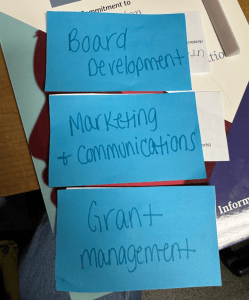
Sometimes that looks like a high-functioning volunteer program. Sometimes it looks like tapping specific board members for expertise, bringing on interns, or exploring fractional leadership to carry key functions like finance, HR, or operations without overhiring.
Fractional Leadership: A Strategic Support, Not a Stopgap
Let’s talk about what we mean by fractional leadership. A fractional leader is a part-time or contract-based expert—someone who takes on a specific leadership function without the full-time price tag. It could be a fractional COO, CFO, or HR Director.
For many nonprofits, this model allows the executive director to focus on what only they can do:
- Strategic capacity without long-term overhead
- Access to expertise during transitions or growth
- Relief for the executive director doing it all
It’s not a sign that your team is broken. It’s a sign that you’re being intentional about how you build capacity over time. Fractional leadership helps the executive director stay grounded in their role—leading the mission, stewarding relationships, and making high-level decisions—instead of drowning in daily operations.
Nonprofit Doesn’t Mean No Money
This one’s critical—and it comes up in nearly every training we lead: Too many nonprofit CEOs and executive directors feel guilt or hesitation around money. Whether it’s:
- Asking for more funding
- Investing in staff
- Paying yourself sustainably
- Or building reserves…
…the emotional resistance is real. We get it. There’s a deep cultural narrative that being mission-driven means being personally sacrificial. But here’s the truth: Being a nonprofit just means you reinvest profits into the mission—it doesn’t mean you shouldn’t generate revenue.
Take one of our recent clients as an example. The executive director earns $500,000 a year. At first glance, that number might seem shocking—but it’s right-sized for a multi-million dollar organization. Compensation should be tied to scope, responsibility, and sustainability—not shame or scarcity.
Strong, well-resourced organizational leadership isn’t indulgent. It’s responsible. And it sets the tone for how everyone else in the organization is treated and supported.
Grant Funding Isn’t a Long-Term Strategy (Alone)
This brings us to another major trap the executive director can fall into—especially newer ones: chasing grants as the only pathway to sustainability. We’ve seen it time and time again: organizations get locked into chasing dollars that don’t align with their mission, that strain their teams, or that disappear after 12 months.
Relying solely on unpredictable grant cycles is risky. Executive directors need to diversify—individual donors, earned income, partnerships, and yes, sometimes, tough calls on what to sunset.
This is especially important in the current climate—with funding being pulled by agencies like the Department of Justice and Education under shifting political leadership. That’s not a call to panic. It’s a call to build resilience:
- Strengthen donor engagement
- Explore earned income aligned with your mission
- Cultivate funder relationships, not just transactions
- Make strategic decisions about programs that are no longer sustainable
Grants may fund the mission, but they can’t be the mission.
Leading with Clarity, Not Capacity
At EvolveTCF, we believe in supporting the executive director to lead—not to overextend. Effective organizational leadership looks like:
- Coaching to help the executive director clarify their role and vision
- Consulting to build systems that support sustainable growth
- Training and facilitation to develop teams that can lead alongside you
- Fractional leadership to take key functions off your plate
Organizational leadership should feel weighty—but it shouldn’t feel crushing. It should feel purposeful—not endless.
Whether you’re an executive director stepping into your first role or a nonprofit CEO leading organizational transformation, remember this: Your job is to lead the mission forward. Not to carry every piece of it yourself.
Missed Another Article in This Series? Check It Out Below:
This post is part of our “You Can’t Do It All—And You’re Not Supposed To” leadership series for the nonprofit Executive Director, board leader, and program team who are building sustainable, people-centered organizations.
Explore the full series:
| Title | Topic |
|---|---|
| Nonprofit Leaders Can’t Do It All—And They’re Not Supposed To (you’re here) | Overview of topics covered in the series |
| The Do-It-All Trap: Why Nonprofit Leaders Must Embrace Delegation | Leadership roles, burnout, and shared workload |
| What Is Fractional Leadership—and Why More Nonprofits Are Embracing It | Strategic staffing and capacity-building |
| “Nonprofit” Doesn’t Mean “No Money”—Let’s Talk About It | Reframing financial sustainability and worth |
| Grant Funding Isn’t a Strategy—It’s a Stream (you’re here) | Funding diversification and long-term planning |
Each one is built to help you lead with clarity, courage, and care—without carrying it all alone.
Want to take these ideas deeper with your team or board? Let’s start a conversation about how we can support you.